How Much Protein Do You Need as You Age?
Have you noticed your body changing as you get older? Maybe you’re seeing a little more fat around your midsection and less muscle tone in your arms and legs. You may feel slightly weaker than you used to, or notice that your metabolism doesn’t feel quite the same.
Many people assume these changes are simply a normal part of aging. While some changes are inevitable, a big piece of what’s happening is something called age-related muscle loss. Starting around midlife, adults gradually begin to lose muscle mass. Over time, this can affect strength, metabolism, balance, and even blood sugar control.
The encouraging news is that lifestyle choices play a major role in how quickly this happens. Two of the most important are adequate protein intake and strength training. Understanding how protein needs change with age can help support muscle maintenance, metabolic health, and physical function over time.
The Four Key Factors That Support Muscle Health as You Age
Maintaining muscle as we age isn’t just about eating more protein. Several factors work together to support muscle maintenance and strength over time.
Four key factors include:
1. Total protein intake
Consuming enough protein throughout the day provides the amino acids needed to maintain and repair muscle tissue.
2. Protein quality
Some protein sources contain higher levels of essential amino acids, particularly leucine, which plays an important role in stimulating muscle protein synthesis.
3. Protein distribution throughout the day
Spreading protein across meals may stimulate muscle protein synthesis more effectively than consuming most of your protein at one meal.
4. Resistance training
Strength training provides the mechanical signal that tells the body to build and maintain muscle, while protein supplies the building materials.
Together, these factors help support muscle maintenance, metabolic health, and physical function as we age.
Why Protein Matters More as You Age
Most people know protein is important. What often gets overlooked is how much more important it becomes as we get older.
Starting around age 30, adults gradually begin to lose muscle mass. Over time, that decline can progress to a condition known as sarcopenia, which is characterized by significant muscle loss and reduced strength.
 Research suggests adults lose about 3–8 percent of muscle mass per decade, with the rate of loss accelerating after age 60.
This loss isn’t just about appearance. Muscle plays an important role in many aspects of health, including:
-metabolism and blood sugar regulation
-strength and mobility
-bone health
-balance and fall prevention
-immune function and recovery
Because muscle is metabolically active tissue, losing muscle can make it harder to maintain strength, energy, and metabolic health over time.
Fortunately, lifestyle factors can significantly influence how quickly this happens. Two of the most important are adequate protein intake and regular strength training.
Anabolic Resistance
Another reason protein becomes more important with age is a phenomenon known as anabolic resistance.
In younger adults, relatively modest amounts of protein can stimulate muscle protein synthesis, the process the body uses to repair and build muscle tissue. Research suggests that younger adults can often maximize this response with roughly 20 grams of high-quality protein in a meal.
As we age, however, the body becomes less responsive to smaller protein doses. Studies suggest that larger protein portions , often closer to 30–40 grams of protein per meal, may be needed to stimulate muscle protein synthesis effectively. In practical terms, this means the same protein intake that supported muscle maintenance earlier in life may not provide the same stimulus later on.
That said, there’s no need to stress about hitting an exact number at every meal. The goal is simply to include a meaningful source of protein throughout the day, rather than consuming very little protein earlier in the day and most of it at dinner.
Protein and Strength Training Work Together
While protein intake is important for maintaining muscle as we age, protein alone isn’t enough. Your muscles also need mechanical load from resistance training to stay strong. Strength training provides the signal that tells the body to build and maintain muscle, while protein provides the amino acids needed to repair and rebuild muscle tissue.
 Think of it this way: protein provides the building materials, while resistance training signals your body to use them. Without that signal from resistance exercise, the body has less reason to maintain muscle mass, even if protein intake is adequate.
The good news is that strength training doesn’t have to be complicated. Activities such as lifting weights, resistance band exercises, or bodyweight movements can all help stimulate muscle maintenance. Even two to three sessions per week can make a meaningful difference in strength, mobility, and physical function over time.
How Much Protein Do You Need as You Age?
The current Recommended Dietary Allowance (RDA) for protein is 0.8 grams per kilogram of body weight per day. However, many researchers believe this amount may not be sufficient to support muscle maintenance as we age.
Several expert groups now suggest that older adults may benefit from slightly higher protein intakes, typically in the range of 1.0–1.2 grams per kilogram of body weight per day.
Higher intakes, around 1.2–1.5 grams per kilogram per day, may be appropriate for individuals who are physically active, recovering from illness, or trying to preserve muscle while losing weight.
For example:
- A 150-pound person may benefit from roughly 75–100 grams of protein per day
• A 180-pound person may benefit from roughly 90–115 grams per day
These amounts are well within safe ranges for healthy individuals and can be achieved through a balanced diet that includes a variety of protein-rich foods.
If you’d like a deeper explanation of daily protein recommendations, you may also find it helpful to read my article on How Much Protein Do You Really Need Per Day?, where I walk through how protein needs are calculated and how they can vary based on activity level, health goals, and body composition.
Choosing High-Quality Protein Sources
Once you know how much protein you need, the next step is choosing sources that support overall health, including digestion, blood sugar control, heart health, and muscle maintenance.
Some protein sources are more efficiently used by the body because of their essential amino acid profile, particularly the amino acid leucine, which plays an important role in stimulating muscle protein synthesis.
 You can think of leucine as a kind of “on switch” for muscle building, helping activate the processes that repair and maintain muscle tissue after eating protein.
In general, animal-based proteins tend to contain higher amounts of essential amino acids, which can be especially helpful as we age. However, plant proteins can absolutely fit into a healthy diet — they may just require a bit more variety and planning.
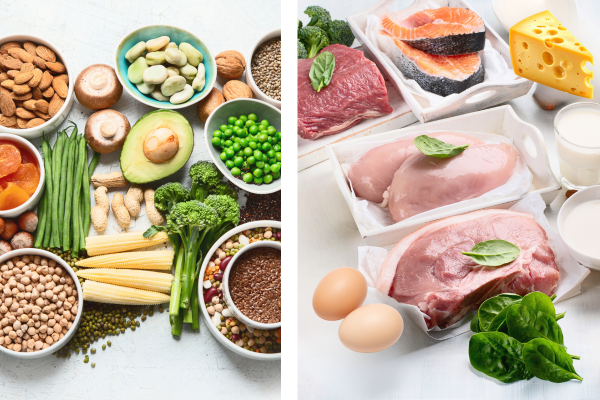
Animal-based protein sources
- Fish and seafood (also provide omega-3 fats for heart and brain health)
• Eggs
• Greek yogurt and cottage cheese
• Chicken and turkey
• Lean beef
Plant-based protein sources
- Lentils, beans, and chickpeas
• Tofu, tempeh, and edamame
• Nuts and seeds
• Quinoa, buckwheat, and amaranth
• Plant-based protein powders
Most people do well with a combination of plant and animal protein sources, depending on their preferences, digestion, and overall health goals.
Does Protein Timing Matter?
Meeting your total daily protein needs is the most important step. However, how protein is distributed across meals may also play a role, particularly as we age.
Many adults consume very little protein at breakfast and most of their protein at dinner. Spreading protein intake more evenly across meals — sometimes referred to as protein distribution — may help stimulate muscle protein synthesis more consistently throughout the day.¹
 Including protein at breakfast, lunch, and dinner may also help regulate appetite. Protein-rich meals stimulate satiety hormones that signal fullness to the brain and may help reduce hunger and cravings later in the day.
Final Thoughts
Protein isn’t just important for athletes. It plays a key role in maintaining muscle, metabolic health, and physical function as we age.
Focusing on adequate total protein intake, protein quality, protein distribution throughout the day, and regular resistance training can help support muscle maintenance and long-term health.
Small changes, such as adding protein at breakfast, spreading protein across meals, choosing high-quality protein sources, and incorporating strength training into your routine, can make a meaningful difference over time.
If you’re looking for personalized guidance on meeting your protein needs, I’d love to help you. Learn more about working with me here.
RELATED POSTS

MEET MARTHA

I especially love problem-solving, whether it’s helping women defeat issues plaguing them for years, helping a busy executive find practical ways to get heart healthy, or providing tips to help you reverse diabetes. That’s why I’m on a constant quest to expand my knowledge by staying on top of the latest research.
2 Comments
Leave a Comment
20 Ways To Eat Out 550 Calories or Less!
No time to cook? We’ve got you covered. Here are 20 healthy meals from a variety of cuisines that won’t pack on the pounds. Most of them also have less than 30 grams of carbs.
Subscribe to my newsletter and get this free download.
Buy Caluanie Muelear oxidize & Red Mecury WhatsApp: +447401473736
Caluaine Muelear Oxidize is one of the most demanded products in the metal or chemical processing sector, This product is used for crushing and processing precious metals and semi-precious stones. It is used for processing precious and semi-precious stones, crushing metals in the chemical industry. this makes it easier to break nails with bare hands after 10-20 seconds of immersion. Heavy water changes the properties of the metal, making it brittle. But at the moment of evaporation of heavy water, the rock returns to its previous state.
Caluanie Muelear oxidize, made in America. our company has an exclusive contract for the supply of Caluanie in USA and Worldwide.
-Type: caluanie muelear oxidize
-Density: 1600 g / l and 1.944 g
-Weight: 1650 g / l 1900 g
-Manufacturer: USA,
-Expiry date: no expiration date
-Characteristics: Embrittlement of metals does not interact with other chemical components
-Do not burn your hands
-Designed for reusable use
-Shipping: Worldwide Delivery
CONTACT IF INETERESTED
We supply other chemicals as well such as SSD, MECURY,
Mercury metal (from latin hydrargyrum = liquid silver) is shiny and silvery and the only metal that is liquid at room temperature. Mercury metal is known since ancient times, when it was believed to be something magical and also a cure for everything. More recently Mercury metal was and still is used in thermometers and barometers and in amalgams as filling for our teeth. Elemental mercury and many of its compounds are very toxic, so it should be avoided and not be used, if there are alternatives. Mercury metal can be sold only in small quantities and perfectly sealed for laboratory or display use. CONTACT IF INTERESTED
Contact Information
Telegram: @Ranko3222
WhatsApp📞: +447401473736
https://toprapidsolution.blogspot.com/
Definitely and totally cured of herpes virus by Doctor Razor’s Quick cure for Herpes. My Sincere Gratitude to Dr Razor, I was infected with HERPES SIMPLEX VIRUS 2 November 13 2018, I went to many hospitals for cure but there was no solution, I was confused because the medical drugs has become my daily food, but i decided to sort after Natural Herbs. One day I sat beside the pool, Browsing and thinking where I could get a solution to end this predicament. I saw a blog on how Herbalist Razor cured people with his herbal medicine, I decided to Visit this Doctor’s Razor Website: herbalistrazorherb.wixsite.com/drrazorherbalhome and being satisfied, I contacted and Explained my Problems to him and he prepared the herbs for me which I took for a period of time and he instructed me to go for a check up, after the test I was confirmed herpes negative, MY JOY KNOWS NO BOUND. This testimony serves as a token of my gratitude.
He renders Treatment for :
HIV/AIDS,
SHINGLES,
CANCER,
HUMAN PAPILLOMA VIRUS,
ASTHMA,
DIABETES
BARRENNESS/INFERTILITY
P*NIS ENLARGEMENT
SPELL COUNSELING.
You Can decide to reach Herbalist Razor on his Email address : drrazorherbalhome@gmail.com . Cell Phone/Whatsapp Number +2349065420442..