Trouble Losing Weight? You Could be Vitamin D Deficient!

Have you been trying to lose weight unsuccessfully? Have you reached a weight loss plateau? If you are frustrated from dieting and exercising without seeing results, a Vitamin D deficiency could be to blame.
Recent studies have shown deficient levels of Vitamin D to be related to increased body fat, including visceral fat – or the fat around the abdomen. The exact mechanism is still not fully understood, but studies have established a correlation between rising rates of obesity and vitamin D deficiency.
What is Vitamin D?
Vitamin D is one of four fat soluble vitamins. It is made naturally in our skin when exposed to sunlight (UV rays). At first, this form of Vitamin D is not biologically active. It is converted in the liver and then in the kidney, to the active form of Vitamin D, calcitriol. Vitamin D helps the gut absorb calcium and phosphorus from food, promotes health of bone and teeth, and helps our immune function. In addition to these benefits, newer research shows adequate amounts of Vitamin D can help you lose weight and lower body fat percentages.
How much do you need?
If you have had trouble losing weight and keeping the pounds off, you may want to consider having your doctor check your Vitamin D level. Optimal levels are 32-55 ng/ml. Levels below 30 ng/ml are considered deficient. The DRIs for Vitamin D are 200 IU for adults under age 50. The DRIs increase to 400 IU/day for adults 51-70 and 600 IU/day for those over 70. Information regarding Vitamin D on nutrition labels is based on the recommended daily intake of 400 IU per day. If your vitamin D level is low, you may want to increase your daily intake above the DRI for your age. *Some experts are even recommending higher intakes of Vitamin D … so stay tuned!
Where can you get it?
Vitamin D status is influenced by both exposure to sunlight and Vitamin D in the diet.  Unfortunately, very few foods contain Vitamin D naturally. The Vitamin D which most Americans get from their diet comes from fortified foods, such as milk. Milk is generally fortified with about 100 IU per cup. Other good sources of Vitamin D include fish, egg yolks, and fortified cereals. Don’t forget UV rays, which trigger your body’s natural production of Vitamin D in the skin. Sun exposure, without sunscreen, for 15-25 minutes a few days per week will allow for adequate synthesis of Vitamin D. But be safe and apply sunscreen after that! The table below lists some foods that provide Vitamin D in the diet.
Food Sources of Vit D (in IU’s)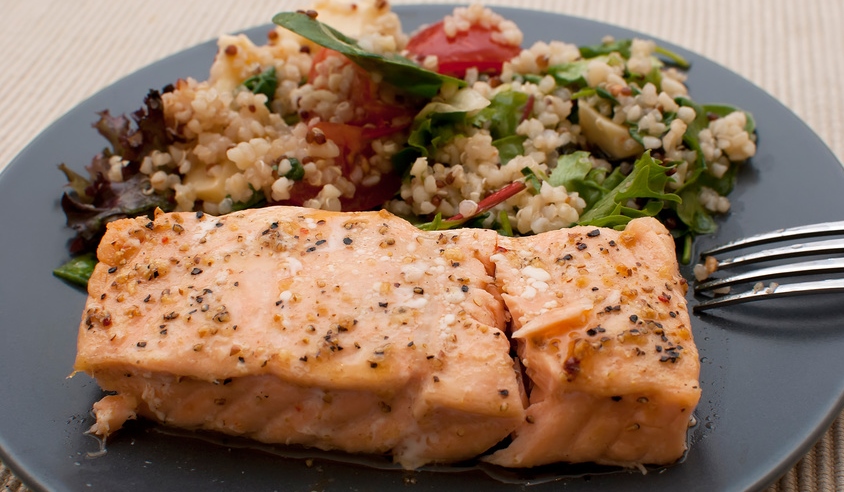
Salmon (~3.5 oz) = 360
Mackerel (~3.5 oz) = 345
Cannned Tuna fish (~3 oz) = 200
1 egg = 20
Swiss Cheese (1 oz) = 12
Fortified breakfast cereals (3/4-1 c) = ~ 40 (varies)
Sardines (1 3/4 oz) = 240
Fortified margarine = 40
Pure cod liver oil (1 tbsp) = 1360
What about supplements?
Vitamin D is supplementally available in two forms: D2 (or ergocalciferol), and D3 (or cholecalciferol). Both forms are regarded as effective, however, D3 may be more effective at raising serum levels. If taking a supplement, chose one that contains a Vitamin D dose of 400-800 IU. Most multivitamins contain at least 400 IU. Also, calcium supplements, such as Calcium carbonate and Calcium citrate contain adequate amounts of Vitamin D.

There is no doubt that Vitamin D is important to your health and nutrition. Aside from helping with your diet, some evidence suggests that Vitamin D can help prevent osteoporosis, heart disease, some cancers and even depression. Ask for a blood test and make sure you are getting enough!
Check out this link for more info on Vitamin D and weight loss
I would like to thank Despina Hyde, RD at NYU Medical Center, NYC for writing this article. Despina also helped me to write the Lunch Survival Guide – so make sure you download it if you haven’t already done so!
RELATED POSTS
Sorry, we couldn't find any posts. Please try a different search.
MEET MARTHA

I especially love problem-solving, whether it’s helping women defeat issues plaguing them for years, helping a busy executive find practical ways to get heart healthy, or providing tips to help you reverse diabetes. That’s why I’m on a constant quest to expand my knowledge by staying on top of the latest research.
20 Ways To Eat Out 550 Calories or Less!
No time to cook? We’ve got you covered. Here are 20 healthy meals from a variety of cuisines that won’t pack on the pounds. Most of them also have less than 30 grams of carbs.
Subscribe to my newsletter and get this free download.